

Chestahedron Seven Sided Geometry

Chestahedron Seven Sided Geometry
This newly discovered shape is known as the “Chestahedron,” and we think it’s one of the most fascinating shapes ever found in mathematics. It’s directly related to all of the platonic solids through a series of transformations, and it was discovered only fairly recently by a man named Frank Chester. He was searching for a seven sided geometry which he thought had to exist, so after several months of experimentation with different shapes and sculptures made in his studio, he finally nailed it. And now here it is, suddenly appearing in our reality for the first time ever in history! Yet it’s indisputably real, and we can also show that it’s mathematically legitimate. After the initial discovery of this shape was established, further analysis revealed several mind blowing properties — which would have never been possible to see before we were able to examine the features of an actual physical form.

Chestahedron Phi Model Definition: The Five Pointed Star Transformation
Further Chestahedron Analysis
Some of the unusual characteristics that Frank found after further analysis of the Chestahedron correlated so perfectly with the attributes of a human heart, that it’s now being classified in some circles as “the geometry of the heart.” It’s also said to contain correlations with the inner geometry of spherical bodies (like planets). We haven’t independently verified this yet. But if it’s true, our planet earth can be theoretically shown to contain this same “geometry of the heart” within it!
We know this might all sound incredibly “Woo Woo,” and we would probably agree if this were just a personal opinion. But in this case, there is nothing to question other than what the math itself is showing us.
The fascinating thing about geometry is that it either works or it doesn’t, and it can’t be forced into giving you incredible outcomes. So it’s always thrilling to uncover astounding results like we’re seeing in shapes like the new Chestahedron Phi Model — which we’re introducing below in Section 3. A circle can’t be forced into giving you one of the well known circle theorems for example, and the reasons why circle theorems work can’t be traced back to an origin or a designer. So geometry is one of the ultimate mysteries. It’s always been there with no one ever having invented it!
Do shapes like the Chestahedron relate to anything in the real world? Though it may not be easy to prove that conclusively in some cases yet, we always have to allow for the possibility because sacred geometry is found throughout nature in so many organic structures. And as you’ll see in this article, what we do have now is a very solid mathematical foundation to move forward with.
Finding A Mathematically Correct Definition

This shape caught our attention right away since it ties in perfectly with so many of our other math research topics. So we wanted to know more, and of course we wanted to nail down the math that makes it tick! :-)
Chestahedron Description
The most interesting way to describe this shape is to look at joining a five pointed star with a tetrahedron. By unfolding three sides of the tetrahedron (a triangular pyramid with four equilateral faces), that would make it open from the top, analogous to a flower bud opening into a blossom. Now think of in-folding three points of a five pointed star and joining that with the out-folding tetrahedron. And there we have a perfect description of how this new shape is formed!
Since we know the building blocks of a Chestahedron are a tetrahedron and a five pointed star, we can anticipate some interesting properties that would be inherent within this shape. The tetrahedron is made up of 4 equilateral triangles which each have a unit height of (root 3) / 2 by definition (which is also known to be half the height of a Vesica Piscis). But the sides of these equilateral triangles are adjacent to the golden triangles of a five pointed star. Since the side unit measure of a golden triangle is equal to the golden ratio (or phi), that means the side lengths of all four of these equilateral triangles would also be equal to the golden ratio!
Defining a New Axiom
Fundamentally however, the only shape needed to define a mathematically perfect Chaestahedron is the five pointed star as shown earlier in our Chestahedron Phi Model Definition Image. So we’ll be using the star shapes from our reference article to establish the foundational math for the new model. If we fold in three sides of a five pointed star until the edges meet perfectly, the equilateral triangles (if they exist) will naturally fall out from the result of that fold. We don’t need to prove this will form an equilateral triangle at the base since this is self evident. When folded from the center of a pentagon, we know the resulting Kite shaped quadrilaterals will be equal, and the edges running along the apex will never meet perfectly unless the fold angles are also equal.
Will The Side Triangles Also Be Equilateral?
Once the five pointed star is folded and the edges meet up to form what we’re calling a pentagonal tetrahedron at the top apex, we know the three base points of the star will be evenly distributed on a flat surface. This means the base triangle will be equilateral for sure, but what about the three adjoining side triangles? We know their side lengths will be equal to the golden ratio because of the adjoining golden triangles, but what about their base lengths? It seems very unlikely that these base lengths would turn out to be exactly equal to the golden ratio as well.
What answers this question is finding the side length of the base equilateral triangle. If that length is equal to Phi, this will prove that our side triangles are also equilateral. We created a new 3d model based on the axiom we just defined so we could do a quick check before moving forward with a proof. To see this new model rotating in 3d, see our 360 animation below.
Creating The New Chestahedron Phi Model

We set up our new 3d Chestahedron Phi Model as shown in Figure 2 with a pentagon having side lengths of one unit, and the golden triangles having side lengths of Phi (the golden ratio). So it’s based on a mathematically correct five pointed star, and you can see how all of the math is derived for this shape by reviewing our Five Pointed Star Reference Shapes.
The tricky part was folding the 3 star points so they joined to form the pentagonal tetrahedron at the top, but we got it so close that the margin of error is within thousandths of a unit. We’re using Sketchup so we can only get so much accuracy out of that program, but it’s plenty good enough to convince us that the three adjoining side triangles are indeed equilateral.
Is There a Solid Mathematical Proof?
We’ve answered our question about the side triangles being equilateral to our own satisfaction by now, because we know our 3d model is very accurate. But we still can’t get around the fact that nothing beats a solid mathematical proof, since this would make that question completely inarguable. Because after all, why would anyone believe us just because we say our 3d model is accurate?
Fortunately, we can write a proof of equality formula to address this after we develop more of the math to describe our “pentagonal tetrahedron” in section 4 below. Since this three sided pyramid at the top of the Chestahedron forms the foundation of our axiomatic definition, we need to establish a new top down derivation for the Chestahedron Phi Model, rather than having it defined from the bottom up like it had been in the past.
The final proof can be found in section 6 below, where we calculate the “Pentagonal Tetrahedron Measurements.” Once we have those measurements, everything else we discover about the New Chestahedron Phi Model will originate from that foundation.
Chestahedron Phi Model 360 Animation
The Pentagonal Tetrahedron

The Chestahedron was never before seen in the world until its discovery by Frank Chester a little over 25 years ago. But according to our new axiom for defining it, this shape relies solely on the result of infolding three points of a five pointed star until the edges join perfectly to form a tetrahedron like shape at the top.
We’re calling this top shape a “Pentagonal Tetrahedron” as shown in figure 3, but why are we calling it that? We gave it that name based on the side triangles which emanate from the center to the outside vertices of a pentagon (which is the foundational shape at the center of a five pointed star).
But this begs the question, has a pentagonal tetrahedron ever been discovered or researched before the emergence of the Chestahedron? Unless we’re missing a description of it somewhere, we can’t find any other reference to it.
This is obviously a critically important shape which lies at the very center of our new Chestahedron Phi Model definition. So to really get down to the bottom of things, this is the first shape we need to analyze further.
Similarities to a Regular Tetrahedron
The first thing to notice is that a regular tetrahedron is made up of four identical equilateral triangles. So while this is a useful shape for reference, the pentagonal tetrahedron does not have four identical triangles! The base triangle is equilateral, but the three side triangles are not. In our main reference article, we derived all of the measurements for a pentagonal triangle, and you can see that it’s more scrunched down in the vertical direction than an equilateral triangle. This means a pentagonal tetrahedron will also be more scrunched down in the vertical direction than a regular tetrahedron.
Important Metrics
Now that we have an undeniably real pentagonal tetrahedron established however, we can define some important metrics relating to it, and thus relating to the overall Chestahedron Phi Model as well. Figure 3 is illustrating some of the key numbers we’re after, one of which being the height of a pentagonal tetrahedron for example. Measurements like this will allow us to travel farther down through the model as we continue to build up a completely new set of metrics for the Chestahedron.
Angle Of The Fold
Another interesting and critically important number to get would be the angle of the original fold we used to create this three dimensional shape. This is known as the “Dihedral Angle,” which is defined as the angle between two planes. The dihedral angle for pyramids (or tetrahedrons) is usually found by calculating the normals of adjoining faces, but this calculation is greatly simplified for pyramids with an apex which is perpendicular to the center of the base. Fortunately this is true for both regular and pentagonal tetrahedrons, so we can easily find these numbers.
Developing The Math
We’ve already done these key calculations and verified that the numbers are correct, so the only thing left to do is publish the math. This is the most crucially important step however, because we’ll be the first to admit that some of these outcomes are very hard to believe. Because of that, showing the math is an absolute requirement to eliminate the possibility that anyone thinks we’re just making stuff up and telling tall tales! No matter how you might personally feel about math (many have a very negative reaction to it), even if you don’t understand it yourself, there are plenty of others who do and they’re exceptionally good at it. So you can rest assured that if anything we claim is incorrect, we have more than enough other math professionals in our audience who will quickly spot the errors.
Don’t Avoid the Article Just Because of the Math!
What this means is, you don’t need to worry about whether some our claims are correct just because you might not personally understand all of the math. We’ve written the article to make sure anyone can follow along and no one is left out. But the exception to this would be someone who rejects the whole thing just because they think they hate math. These are exactly the ones who we would encourage to read further. Because you might discover that you actually do have an interest in math, but never knew it because of the “boring way it was presented in school.” This statement comes up from our readers a lot, so we need to address it.
If math really is one of the greatest mysteries in the universe (as we’ve eluded to earlier), does that sound like a boring subject? Also note that most of the math we used is not that complex, and many of our readers should already be familiar with it from just the basic math requirements you’ll encounter in any standard college curriculum.
Additional Math Resources

If you do discover a yearning to learn more about math (like we did early on too), we have plenty of resources to help. In particular, our Foundations of Math Books Collection will give you a very strong background to understand all of the basics, and you’ll be surprised at how far just a better understanding of basic algebra will take you. Going just a little further, an Algebra Combined With Trigonometry book will deliver you through the vast majority of anything you’ll ever encounter! Most people don’t realize how much of math and engineering relies on just these two fields alone, and they provide the critical cornerstone that makes up virtually all of higher math as well!
In addition to that, our Math Tools section gets into the fun stuff — which is just as powerful (if not even more powerful than the books) for helping you to learn and understand math. Nothing beats laying it down on paper or doing experiments with physical models, and Frank Chester himself would be the first one to tell you that! Anyone can benefit from using these tools, even if they have no book knowledge on the subject at all!
But before we begin, the best place to start is by taking a closer look at another timeless shape which appears repeatedly throughout our Chestahedron Phi Model (and also at the base of our Pentagonal Tetrahedron). This is of course the venerable “Equilateral Triangle,” and we’ll need to explore the math behind that first — so we can derive some of the numbers for solving the green triangle measurements illustrated in Figure 3.
Exploring The Equilateral Triangle

Next to the circle, the equilateral triangle is probably the most significant shape in all of geometry. If it could be said that all shapes in nature are trying to become circles, could it also be said that all triangles are trying to become equilateral? In fact this triangle is closely related to the circle, so it seems like that would be the logical sequence of transformations. It’s conceptually beautiful and simple to create, so it provides a great companion tool for building projects.
Back in earlier times, carpenters would use it to establish the peak of a roof on a house by simply allowing the floor width to be the base of an equilateral triangle. Wherever the apex ended up (which was simple to determine with equal measurements), that was the peak of your roof! This also provided a nice way to incorporate sacred geometry into your house, and they did look strong and beautiful when constructed that way. The definition of this triangle is straight forward as we can describe below.
Definition
An equilateral triangle is a triangle with all three sides of equal length $s$, corresponding to what could also be known as a “regular” triangle. An equilateral triangle is therefore a special case of an isosceles triangle, having not just two, but all three sides equal. An equilateral triangle also has three equal 60 degree angles as shown in Figure 4.
The altitude or height $h$ of an equilateral triangle would be,
\begin{align}
h = s\sin \left(60^{\circ} \right) = \frac{\sqrt{3}}{2}s \\
\end{align}
where $s$ is the side length. The area $A$ would then be defined as,
\begin{align}
A = \frac{1}{2}hs = \frac{\sqrt{3}}{4}s^2 \\
\end{align}
Emerging Chestahedron Metrics
As you can see, we already have some valuable metrics emerging for the Chestahedron since we know the base triangle of the Pentagonal Tetrahedron is equilateral with $s = 1$. Furthermore, if we can prove the four triangles along the sides and base of the Chestahedron are identical and equilateral, they should all have identical side lengths of $\; s = \varphi$.
We already know the star points in the Kite shapes are golden triangles with side lengths equal to $\varphi$. So we know the adjoining side triangles will automatically have side lengths of $\varphi$ also. If they’re equilateral, all side lengths will be equal to $\varphi$, and that automatically implies the base triangle will need to have those same side lengths equal to $\varphi$ as well!
So the equilateral triangle is proving to be an indispensable tool for evaluating the Chestahedron, and we can continue to collect more information from it as shown below in Figure 5.

Figure 5: Equilateral Triangle Centroid Definition
Equilateral Triangle Centroid
The “center” of an equilateral triangle, often referred to as the centroid, incenter, circumcenter, or orthocenter, is a single point that is equidistant from all three vertices and all three sides of the triangle. This is the measurement we need for determining the height of our pentagonal tetrahedron. But while we’re at it, we’ll go ahead and get numbers for some of the other related shapes shown in Figure 5 as well.
The inradius $r$ and circumradius $R$ can be computed directly from the formulas for a general regular polygon with side length $s$ and $n = 3 \;$ sides,
\begin{align}
r = s\frac{1}{2}\cot \left(\frac{\pi }{3}\right) = s\frac{1}{2}\tan \left(\frac{\pi }{6}\right) = \frac{1}{6}\sqrt{3} \;s \\\\
R = s\frac{1}{2}\csc \left(\frac{\pi }{3}\right) = s\frac{1}{2}\sec \left(\frac{\pi }{6}\right) = \frac{1}{3}\sqrt{3} \;s \\\\
\end{align}
While we’re at it, we might as well also get the areas of the two circles shown in green in Figure 5, since they’re easy to derive from what we have established above. These are defined as the incircle area $A_r$ and circumcircle area $A_R$, and they’re calculated as follows,
\begin{align}
A_r = \pi r^2 = \frac{1}{12}\pi s^2 \\\\
A_R = \pi R^2 = \frac{1}{3}\pi s^2 \\\\
\end{align}
Pentagonal Tetrahedron Measurements
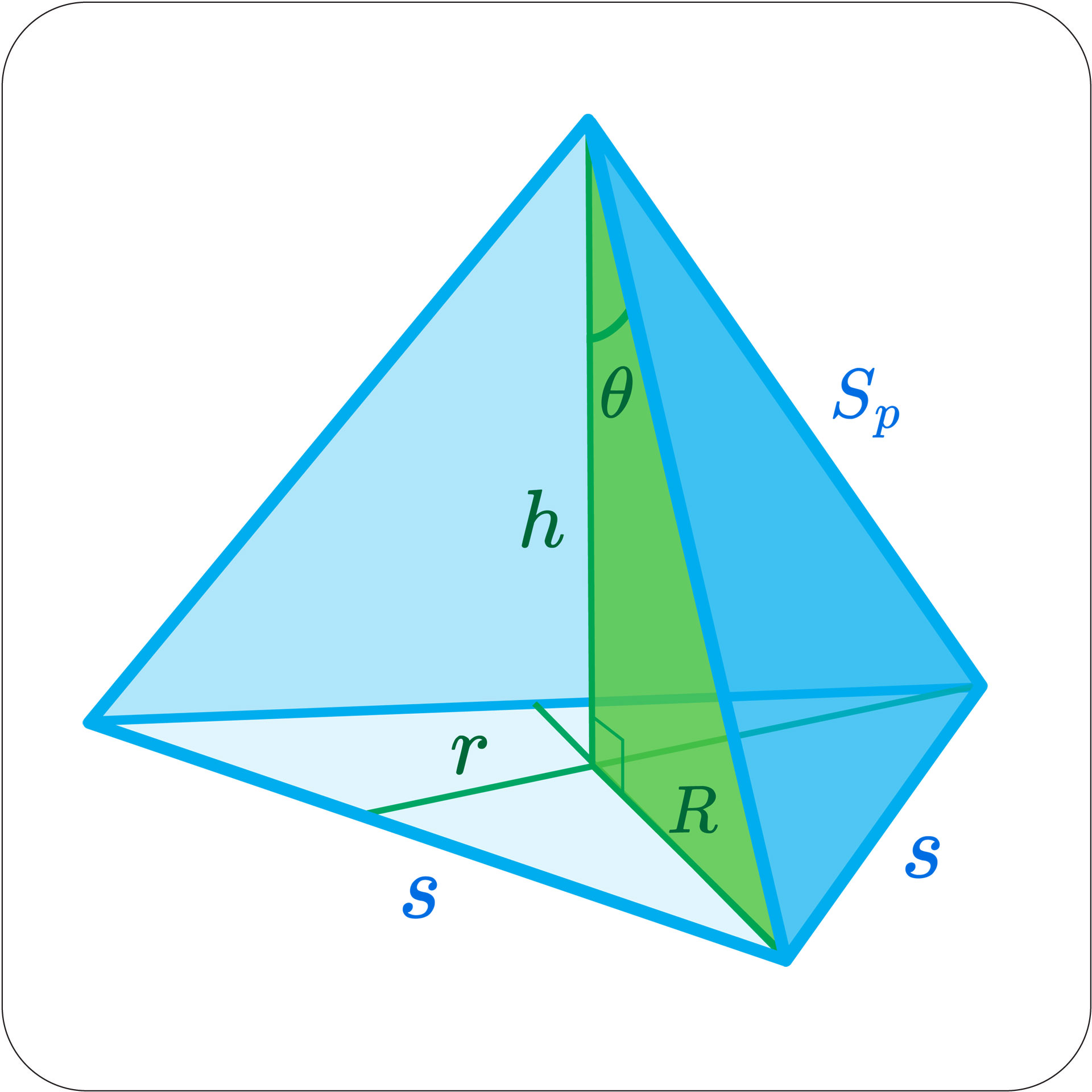
By applying what we established above for the equilateral triangle, we’ve revealed a new set of useful tools for evaluating the pentagonal tetrahedron as shown in Figure 6.
Height of The Pentagonal Tetrahedron
If we let $h$ be the height of our tetrahedron with base length $s = 1 \;$, we can solve for $h$ using the Pythagorean Theorem,
\begin{align}
h^2 = S_p^2 \; – \; R^2
\end{align}
where $S_p$ is the side length of a pentagonal triangle, and this calculation was derived earlier in our reference article,
\begin{align}
S_p = \frac{2}{\sqrt{2}\sqrt{5 \; – \; \sqrt{5}}} \\\\
\end{align}
Plugging these numbers into a calculator and solving for $h$, we get $h = 0.6247187082$, which is very close to the measurement we took from our 3d model in Sketchup – which was $0.624720$.
Finding the Apex Angle
From here, we can also find the apex angle $\theta \;$ shown in Figure 6.
\begin{align}
\sin \left(\theta \right) = \frac{R}{S_p} \\\\
\theta = \sin^{- 1}\left(\frac{R}{S_p}\right) = 42.74338393^{\circ} \\\\
\end{align}
Finding the Elevation Angle

What might be an even more useful angle to find in addition to $\theta$ would be the elevation angle $\alpha$ shown in Figure 7. We can use the same formula as we used for $\theta$, but relating it to the inradius $r$ instead of the circumradius $R$, and using the height $H_p$ rather than the side length $S_p$ of the pentagonal triangle derived in our reference article,
\begin{align}
\sin \left(\alpha \right) = \frac{r}{H_p} \\\\
\alpha = \sin^{- 1}\left(\frac{r}{H_p}\right) = 24.80110087^{\circ} \\\\
\end{align}
Height of the Chestahedron Phi Model
The nice thing about the elevation angle is it gives us a quick way to check the overall height of our New Chestahedron Phi Model. The angle $\alpha$ is the same as the elevation angle of the “Kite” shape formed by one of the in-folded points of a five pointed star as shown in Figure 8.
We can get the height of the Kite shape $H_k$ by letting $H_g$ be the height of the golden triangle derived earlier in our reference article, and adding that to our height of the pentagonal triangle $H_p$.
\begin{align}
H_k = H_p + H_g \\
\end{align}

If we let $H_c$ be the overall height of the New Chestahedron Phi Model, we can find this height with the following calculation,
\begin{align}
H_k \; cos \left(\alpha \right) = H_c \\\\
H_c = 2.021632207 \\
\end{align}
So the calculated height $H_c$ of our Chestahedron Phi Model is $2.021632207$, which is very close to the measurement we took in Sketchup — which was $2.021635$. So while we weren’t able to show this height as being exactly equal to two, as we had wondered about before we did the math, we did manage to show that our Sketchup 3d model is quite accurate!
Proof That Side Triangles Are Equilateral
So far we haven’t provided any mathematical proof to show that the side triangles of our Chestahedron Phi Model are truly equilateral. Our 3d Sketchup model is very accurate, and our measurements were close enough to convince us that this was the case. But now we have a nice way to prove that using the elevation angle!
By modifying our equation for $H_c$ from above, we can find the circumradius $R$ of the base triangle in the Chestahedron. Since the inradius $r$ can be expressed as $R/2$, we can see from Figure 5 that the height of the base triangle would be equivalent to,
\begin{align}
R + r = R + \frac{R}{2} = \frac{3R}{2}
\end{align}
Whatever this result is should be the same as the standard height equation $h_s$ for an equilateral triangle with side length $s = \varphi$, as should be the case with the base triangle in our Chestahedron Phi Model.
\begin{align}
h_s = \frac{\sqrt{3}}{2}s = \frac{\sqrt{3}}{2}\left(\frac{1 + \sqrt{5}}{2}\right) = 1.401258538
\end{align}
If these two results are equal, this will provide us with the proof we’re after.
So the next step will be to find the circumradius $R$ of the base triangle, and this is given by our modified formula for $H_c$ from above. To do that, we again let $H_k$ be the Kite shape height, and this time we use the sine value of $\alpha$ to get $R$,
\begin{align}
H_k \; sin \left(\alpha \right) = R \\\\
R = 0.9341723593 \\
\end{align}
Next, we can let our proof height be $h_p$ and calculate that as follows,
\begin{align}
h_p = \frac{3R}{2} = 1.401258538
\end{align}
So this shows that $h_p = h_s$, and that completes the proof!
Finding The Dihedral Angle
One of the most important numbers to determine is what exactly is the angle of that fold when you’re in-folding a five pointed star? This is the angle $\phi$ shown in Figure 7. If you have that angle, you can be dead on accurate when you’re creating these models in a 3d program or modeling them physically!
The angle formed between a folded plane is called a “Dihedral Angle,” and the calculations for those are more complex with irregular pyramids. But the formula is greatly simplified when the sides are equal, and the apex is perpendicular to the center of the base. Fortunately, just like with a regular tetrahedron, this is also the case with a pentagonal tetrahedron. So we can easily get a very accurate number for the dihedral angle of that critically important fold!
The simplified calculation for the folded plane dihedral angle $\phi_f$ of a pentagonal tetrahedron is given by,
\begin{align}
\phi_f = 2\sin^{- 1}\left(\frac{s}{2H_p}\right) = 93.19463937^{\circ} \\
\end{align}
where the base length is $s = 1$, and $H_p$ is the height of our pentagonal triangle shown earlier. This would be giving us the folded plane value by extension, so the supplemental angle $\phi$ would be given by subtracting $\phi_f$ from 180 degrees.
\begin{align}
\phi = 180^{\circ} – \; 93.19463937^{\circ} = 86.80536063^{\circ} \\
\end{align}
Lower Section of the Chestahedron Phi Model
Based on what we’ve established so far, we can work our way down into the lower section of the Chestahedron Phi Model. Using the centroid measurements defined above, we can see a nice way to calculate the elevation angles for the equilateral triangles on the sides. And at the same time, we can also get the distance between the equilateral triangle at the base of the pentagonal tetrahedron and the base of the Chestahedron. We’ll do both of those calculations in the next section.
Chestahedron Side Triangle Elevation

In Figure 9, we’re looking at an X-Ray view of the new chestahedron phi model showing the centroid measurements for the two base equilateral triangles present in the model. For the base of the chestahedron, we can call these values $r_1$ and $R_1$. And for the base of the pentagonal tetrahedron, those are represented by $r_2$ and $R_2$.
By observing the fact that both centroids are perpendicular with the apex, we can see how the top of the chestahedron side triangle is tilted out by a distance of $R_2 \; – \; r_1$. This gives us a measurement for constructing the blue right triangle in the illustration, and we can solve for the angle of elevation $\alpha_e$.
From the formulas we derived earlier for the centroids of equilateral triangles, we can see that,
\begin{align}
R_2 \; – \; r_1 = \frac{\sqrt{3}}{3} \; – \; \frac{\sqrt{3}}{6}\left(\frac{1 \; + \; \sqrt{5}}{2}\right) \\
\end{align}
The hypotenuse of the blue right triangle in Figure 9 would be simply the height of the side equilateral triangle $H_{st}$,
\begin{align}
H_{st} = \frac{\sqrt{3}}{2}\left(\frac{1 \; + \; \sqrt{5}}{2}\right) \\
\end{align}
Then the angle of elevation $\alpha_e$ for the side triangle would be,
\begin{align}
\alpha_e = \cos^{- 1}\left(\frac{R_1 \; – \; r_2}{H_{st}}\right) = 85.48676788^{\circ} \\\\
\end{align}
The supplemental angle of $\alpha_e$ would then be the internal dihedral angle of of the side triangles,
\begin{align}
180^{\circ} – \; 85.48676788^{\circ} = 94.51323212^{\circ} \\
\end{align}
Distance Between Base Triangles
Now that we have the elevation angle $\alpha_e$ for the side triangle, it’s easy to calculate the distance $d$ between the base equilateral triangle of the Pentagonal Tetrahedron and the base equilateral triangle of the Chestahedron,
\begin{align}
d = sin\left(\alpha_e\right)\left(\frac{\sqrt{3}}{2}\left(\frac{1 \; + \; \sqrt{5}}{2}\right)\right) = 1.396913498 \\
\end{align}
This is again very close to the measurement we took from our 3d Sketchup model, which was 1.396915.
Chestahedron Phi Model Hexagon
We found a very interesting position where a Hexagon will sit perfectly around the outside edges of our new Chestahedron Phi Model, and the numbers are mind blowing. We know exactly where it is and why it’s there, and we’ve got a proof below that shows how it’s possible! A hexagon is one of the most powerful geometric shapes around, and from it you can derive many other important shapes, like the cube, the six pointed star, the flower of life, and the seed of life!
One of the nice things about a hexagon is it gives us a glimpse into a horizontal slice of the internal angles (below the pentagonal tetrahedron). So there is no need for any fancy calculations, since we already know those are 120 degrees. These angles aren’t truly dihedral since they aren’t perpendicular to the edges. But they’re interesting nonetheless, and they might eventually reveal more interesting properties related to the lower inside section of the shape. To see the true dihedral angle between the Kite Shape and the Equilateral Side Triangle, we developed the math to calculate normal vectors for those two planes in section 9 below.
In Figure 10, we’re showing a parallel projection of our New Chestahedron Phi Model in X-Ray view, where we’re demonstrating how it relates to our golden triangle illustration for deriving phi.

Figure 10: Chestahedron Phi Model Hexagon
Finding The Hexagon
If you imagine running a rubber band up the sides of a Chestahedron, you can see that it will reach a certain point where it forms a perfect hexagon with 6 equal sides. Figure 10 above shows exactly where this point is, and it gives us the side measurements of the hexagon as well. These numbers are really kind of unbelievable when you see them, and you’ll want to review our derivation of phi from the golden triangle at the link below to satisfy yourself that all of this is legitimate.
The Golden Inverse
The key takeaway from Figure 10 is, we already know from our golden triangle calculations that $\; y = \varphi$, and the side lengths of the hexagon $S_h$ will be equal to $x$ (from our proof below, showing how we know the side lengths are all equal and thus giving us a perfect hexagon).
\begin{align}
x = S_h = \varphi \; – \; 1 = \frac{1}{\varphi } \\
\end{align}
So this is quite an interesting inverse relationship, because in this case it’s related to $\varphi$ — which is equal to the side lengths of the four equilateral face triangles of the Chestahedron!
Note that on a graph of $y = 1/x$, when $x = 1/\varphi$, this is the point on the graph where $y$ will be exactly equal to the golden ratio. So the curve formed by that starting point (which we could call the “Golden Inverse“) is something we should take a closer look at!
On another side note, we proved a direct correlation in our golden triangle calculations with the $y = 1/x$ equation. So it should really come as no surprise to be seeing an inverse relationship in any shape that’s related to the classic five pointed star. In addition, since we proved that $y = \varphi$ in those calculations, this automatically proved that $x = 1/\varphi \;$ as well.
Proof That Hexagon Side Lengths Are Equal
Since the line $AD = 1$ as we can see in Figure 10, we can form a smaller golden triangle having its apex at point $A$ and side lengths equal to one. The base length of this new similar golden triangle will then be the side length of the hexagon $S_h$. This would be the side of the hexagon that runs along the Kite shapes. At this point we should also notice that triangle $\bigtriangleup BCD$ is identical to our new smaller triangle with apex at $A$, and this means that its base length is $\; x = S_h$. Since the other adjacent side triangles of the Chestahedron are equilateral, we can construct a smaller and similar equilateral triangle at the top (with apex at point $C$) having side lengths equal to $x$. From there it’s easy to see why the base of this smaller side triangle would also be equal to $x = S_h$ (since equilateral triangles always have the same side lengths).
So this satisfies the condition that all sides of the hexagon are equal, and it proves that we have a perfect hexagon at a certain elevation in the Chestahedron Phi Model. The proof is showing us exactly where the hexagon is, and perhaps even more importantly, it’s also showing us why it’s there!
The Golden Vortex
Chestahedron research should not be living and dying on the hill of only its heart related connections alone however, because there are so many more things we don’t know about it yet. Like what about its effect on energy and magnetism, and things like structured water? Because of the Golden Inverse relationship outlined above, we have a hexagon with vortex math related to its side length, and the circular opening of that vortex starting at the point where the radius $r = \varphi$. So a golden vortex? That’s a new one on us, and more work needs to be done to figure out what’s really going on there.
Viktor Schauberger was very interested in using that same vortex model (based on the $y = 1/x$ graph) for structuring water, and we like to think he would have been all in on investigating the golden inverse relationship in the Chestahedron! And if it does relate to the heart, you can see why a really cool feature of that geometry would be to have a “golden vortex” structuring our blood the same way! We’re going out on a limb until this can be verified, but it’s a fascinating possibility!
Divine Triangle Relationship
We had also been looking for a relationship between the Chestahedron Phi Model and the Divine Triangle (known in mathematics as the Golden Gnomon) — since we knew it had to be there. As luck would have it, our hexagon proof revealed where it is and why it’s significant. Note that Triangle $\bigtriangleup ABD$ in Figure 10 meets the definition of a Divine Triangle from our reference article. And guess what’s sitting right at the apex of it? The divine triangle’s apex at point $D$ is located at the exact horizontal elevation point where the hexagon appears in our model!
Relationship With Pentagonal Triangles

The Divine Triangle appears repeatedly throughout the five pointed star and the pentagon, and it also has an interesting relationship with the pentagonal triangles. We could consider the pentagonal triangle to be the most fundamental building block in the definition of our Chestahedron Phi Model. So we need to recognize the importance of the Divine Triangle as well, since these triangles are actually two different faces of the same coin!
In our Five Pointed Star Reference Shapes article, we can see many fascinating relationships between the angles of the pentagonal triangles, the golden triangles, the divine triangles, and obviously with the pentagon. What’s really interesting however, is what happens when we stack and invert two triangles to form what we’re calling a “Pentagonal Triangle Rhombus” as shown in Figure 11.
We’re showing two pentagonal triangles attached at the base horizontally — but oriented in opposite directions vertically. But look at what happens with the angles. In that same image without changing anything, you also have two Golden Gnomons (Divine Triangles) attached at the base vertically, but oriented in opposite directions horizontally.
So a Pentagonal Triangle Rhombus is also a Golden Gnomon Rhombus at the same time! This is an important feature to recognize, since it demonstrates one of the most fundamental oscillating properties found in a classic five pointed star.
In our Star Fort Crystal Geometry & Construction article, we discovered a fascinating new shape which is very closely related to the Chestahedron! This shape is constructed the same way, but using a secondary five pointed star rather than the classic pentagram star we use for the Chestahedron’s construction. In that case, instead of the Kite shapes we have on the sides of the Chestahedron, the Star Fort Crystal is replacing those with the Pentagonal Triangle Rhombus!
Once again, the angles and measurements in this new shape are equally miraculous, and it was as if we had finally brought home the Chestahedron’s long lost relative!
Calculating Normal Vectors

When we’re working with shapes in 3d space, we often need to evaluate characteristics of the planes that make up the surface. One of the best ways to do this is by developing vector equations for each of the individual planes. Since any plane can be defined by three unique points, vector equations can be derived from those points. Once we have this esablished, we can calculate the “normal vectors” which are perpendicular to the planes.
To understand normal vectors, if you imagine holding a dowel rod with a flat plate firmly attached at the end so it’s perpendicular, you can get a sense of how much information this perpendiular vector is giving you. No matter where you move it in any direction, the dowel rod is giving you the exact orientation of the plate (or the plane’s position in 3d space).
In this case, we’re interested in getting the normal vectors for the Chestahedron Phi Model — since we need those to calculate the dihedral angles $\varepsilon$ between the kite shapes and the equilateral side triangles.
Defining Point Sets For Each Plane
In Figure 12, we’re showing a nice way to esablish three points for each of these planes. The Kite shape plane can be defined by three points $ \bigtriangleup ABD$, and the equilateral side triangle can be defined by points $ \bigtriangleup BCD$.
Notice that some of these points ($B$ and $D$) are shared by both planes, so we only have to derive them once. Also notice that the Chestahedron base triangle centroid is oriented at the origin of the $\; x,y \;$ plane, and the circumradius $R$ of the base is oriented along the $x$ axis where $y = z = 0$. So point $D$ is given by,
\begin{align}
D_{xyz} = \left(R,0,0\right) = \left(0.934172359,0,0\right) \\
\end{align}
We can also see that point $A$ is easy to get from the overall height of the Chestahedron $H_c$ derived earlier, since $x = y = 0$ at that point,
\begin{align}
A_{xyz} = \left(0,0,H_c\right) = \left(0,0,2.021632207\right) \\
\end{align}
We can get point $C$ next, by observing from Figure 5 that the angle between $R$ and $r$ is 60 degrees,
\begin{align}
C_{xyz} = \left(r\cos \left(60^{\circ}\right),r\sin \left(60^{\circ}\right),0\right) = \left(0.2335430898,0.4045084972,0\right)\\\\
\end{align}

To get point $B$, we only need to add the tilt distance $t$ of the equilateral side triangle shown in Figure 13 to the inradius $r$ of the base triangle. Then we can recalculate the $x,y$ values the same way we did for point $C$ above. The $z$ value would be the distance $d$ we derived earlier in our side trianlge elevation angle calculations from Figure 10.
\begin{align}
B_{xyz} = \left(\left(r + t\right)\cos \left(60^{\circ}\right),\left(r + t\right)\sin \left(60^{\circ}\right),d\right) \\
\end{align}
The tilt value $t$ is given by the height of the side equilateral triangle $H_{st}$ multiplied by the cosine of the elevation ange $\alpha_e$.
\begin{align}
t = H_{st}\cos \left(\alpha_e\right) = 0.1102640896 \\\\
B_{xyz} = \left(0.2886751346,0.4999999999,1.396913498\right) \\
\end{align}
Now that we’ve defined all of the points we need, we can start writing vector equations for the two planes $ \bigtriangleup ABD$ and $ \bigtriangleup ABD$ shown in Figure 12.
Vector Equations For Kite Shape
Starting with the Kite shape, we can define the two vectors $\overrightarrow{BA}$ and $\overrightarrow{BD}$,
\begin{align}
\overrightarrow{BA} = \left\langle – 0.2886751346, – 0.4999999999,0.624718709\right\rangle \\
\overrightarrow{BD} = \left\langle 0.6454972244, – 0.4999999999,-1.396913498\right\rangle \\
\end{align}
The normal vector for the Kite shape $\overrightarrow{N_k}$ would be the cross product of $\overrightarrow{BA}$ and $\overrightarrow{BD}$,
\begin{align}
\overrightarrow{N_k} = \overrightarrow{BA} \times \overrightarrow{BD} \\
\end{align}
Next, we can set up the vector cross product equation in a 3×3 matrix with unit vectors $i, j$, and $k$,
\begin{align}
\overrightarrow{N_k} = \left|\begin{array}{cc} \overrightarrow{i} & \overrightarrow{j} & \overrightarrow{k} \\ – 0.2886751346 & – 0.4999999999 & 0.624718709 \\ 0.6454972244 & – 0.4999999999 & – 1.396913498 \\ \end{array}\right| \\\\
\overrightarrow{N_k} = (1.010816103)\overrightarrow{i} + (0.000000006)\overrightarrow{j} + (0.4670861794)\overrightarrow{k} \\
\end{align}
So we can write the normal vector for the Kite shape $\overrightarrow{N_k}$ as follows,
\begin{align}
\overrightarrow{N_k} = \left\langle 1.010816103, 0.000000006,0.4670861794\right\rangle \\
\end{align}
Vector Equations For Equilateral Side Triangle
For the equilateral side triangles, we can define the two vectors $\overrightarrow{DB}$ and $\overrightarrow{DC}$
\begin{align}
\overrightarrow{DB} = \left\langle – 0.6454972244,0.4999999999,1.396913498\right\rangle \\
\overrightarrow{DC} = \left\langle -0.7006292692, 0.4045084972,0\right\rangle \\
\end{align}
The normal vector for the equilateral side triangle $\overrightarrow{N_e}$ would be the cross product of $\overrightarrow{DB}$ and $\overrightarrow{DC}$,
\begin{align}
\overrightarrow{N_e} = \overrightarrow{DB} \times \overrightarrow{DC} \\
\end{align}
Then using the same technique as our formula for the Kite shape, we can set up the cross product for the two equilateral triangle vectors in a 3×3 matrix format,
\begin{align}
\overrightarrow{N_e} = \left|\begin{array}{cc} \overrightarrow{i} & \overrightarrow{j} & \overrightarrow{k} \\ – 0.6454972244 & 0.4999999999 & 1.396913498 \\ -0.7006292692 & 0.4045084972 & 0.0 \\ \end{array}\right| \\\\
\overrightarrow{N_e} = (-0.5650633798)\overrightarrow{i} \; – \; (0.9787184832)\overrightarrow{j} \; + \; (0.0892055223)\overrightarrow{k} \\
\end{align}
So we can write the normal vector for the equilateral side triangle $\overrightarrow{N_e}$ as follows,
\begin{align}
\overrightarrow{N_e} = \left\langle -0.5650633798,-0.9787184832,0.0892055223\right\rangle \\
\end{align}
Finding The Dihedral Angle
To find the dihedral angle between two planes, we can use normal vectors defined in the following form,
\begin{align}
\overrightarrow{n_1} = \left\langle p_1,q_1,r_1\right\rangle \\
\overrightarrow{n_2} = \left\langle p_2,q_2,r_2\right\rangle \\
\end{align}
If the acute angle between these planes is $\lambda$, then the dihedral formula would be given as shown below:
\begin{align}
\cos \left(\lambda \right) = \frac{\overrightarrow{n_1} \cdot \overrightarrow{n_2}}{\overrightarrow{n_1} \; \overrightarrow{n_2}} \\
\end{align}
This can also be written in the following way,
\begin{align}
\cos \left(\lambda \right) = \frac{\left|p_1p_2 + q_1q_2 + r_1r_2\right|}{\sqrt{p_1^2 + q_1^2 + r_1^2}\sqrt{p_2^2 + q_2^2 + r_2^2}} \\
\end{align}
Now we can plug this definition into our normal vectors $\overrightarrow{N_k}$ and $\overrightarrow{N_e}$ and solve for $\lambda$,
\begin{align}
\cos \left(\lambda \right) = \frac{\overrightarrow{N_k} \cdot \overrightarrow{N_e}}{\overrightarrow{N_k} \; \overrightarrow{N_e}} = 0.4194695238 \\\\
\lambda = \cos^{- 1}\left(0.4194695238\right) = 65.19889916^{\circ} \\
\end{align}
This is giving us the acute exterior angle of the intersecting planes (by extension). So to find the interior dihedral angle $\varepsilon$ shown in Figures 12 and 14, between the Kite shape and the Equilateral Side Triangle, we can get the supplemental angle of $\lambda$ by subtracting this result from $180^{\circ}$,
\begin{align}
\varepsilon = 180^{\circ} – \; 65.19889916^{\circ} = 114.8011008^{\circ} \\
\end{align}
In Figure 14, we’re showing a quick reference graphic for the New Chestahedron Phi Model Angles & Measurements. The face angles and dihedral angles are shown in black, and our edge measurement variables are shown in red or white. The measurement variables are given by values derived earlier in our reference article,
\begin{align}
\varphi = \frac{1 + \sqrt{5}}{2} = 1.618033989 \\\\
S_p = \frac{2}{\sqrt{2}\sqrt{5 \; – \; \sqrt{5}}} = 0.8506508084 \\
\end{align}
Volume and Surface Area

We were thinking there might be a nice way to find the volume of the Chestahedron Phi Model by relating it to a larger Pentagonal Tetrahedron. The volume of a triangular pyramid is easy to find with a simple formula,
\begin{align}
V_P = \frac{1}{3}BH
\end{align}
where $B$ is the base triangle area, and $H$ is the vertical height of the pyramid from the base to the apex. So if we can break this problem down into finding volumes of pyramids, it should be relatively easy to solve.
The first thing we need to find out is what would happen if we extend the edges of the top pentagonal tetrahedron until they intersect the same flat surface as the base of the Chestahedron. We used three straight edges to get a rough idea, and in Figure 15 we’re making our claim on what appears to be happening.
If this claim is true, the base of our new larger tetrahedron $ \bigtriangleup CEG$ would be made up of 4 equilateral triangles which are all identical to the base and side triangles of the Chestahedron! It seems rather unlikely that this would actually happen, so we need to make sure this is exactly the case, and not just close to being true.
Mathematical Proof of Claim in Figure 15
We can use the same process we covered for proving the side triangles of the Chestahedron were equilateral. So in other words, we can find the derived height of this larger base triangle using the apex angle $\theta$ (of the pentagonal tetrahedron that we calculated earlier), and then check to see if that’s equal to the height that it should be if our claim is correct.
First we need to find the new diagonal $AG$ of the larger tetrahedron, and we already have the height of this pyramid since it will be the same as the Chestahedron height $H_c$.
\begin{align}
\cos \left(\theta \right) = \frac{H_c}{AG} \\\\
AG = 2.752763841 \\
\end{align}
Next, we can get the circumradius $R$ of this larger base triangle,
\begin{align}
\sin \left(\theta \right) = \frac{R}{AG} \\\\
R = AG\sin \left(\theta \right) = 1.868344718 \\
\end{align}
We can let $H_{ptd}$ be the derived height of the base triangle for our larger pentagonal tetrahedron, and $H_{ptc}$ can be the claimed height that it should be if we’re correct. We can also let $CE$ be the side length of this triangle, which should be equal to $2\varphi$.
\begin{align}
H_{ptc} = \frac{\sqrt{3}}{2}CE = 2\varphi \frac{\sqrt{3}}{2} \\\\
H_{ptc} = 2.802517077 \\
\end{align}
Now we can find $H_{ptd}$ since we already solved for $R$ from above,
\begin{align}
H_{ptd} = \frac{3R}{2} \\\\
H_{ptd} = 2.802517077 \\
\end{align}
So we’ve shown that $H_{ptd} = H_{ptc}$, and we know that our claim regarding Figure 15 from above is correct!
Volume of Large Pentagonal Tetrahedron
Now that we have proof that our larger pentagonal tetrahedron is doing what we claimed, it will be fairly easy to find the volume of the Chestahedron Phi Model.
The first step will be to find the overall volume of this larger tetrahedron $V_{pt}$. Then we can find the volume the 3 irregular tetrahedrons that join with the equilateral side triangles of the Chestahedron. The volume formula is the same for both regular and irregular pyramids with a triangular base, so these values will be easy to calculate as well. And once we find them, we can subtract their combined volume from $V_{pt}$. Then what’s left over will be the volume of the Chestahedron!
Recall that the volume of our larger pentagonal tetrahedron will be given by,
\begin{align}
V_{pt} = \frac{1}{3}BH \\\\
\end{align}
where $B$ is the area of the base triangle, and $H$ would be the height of our Chestahedron Phi Model $H_c$ calculated earlier. And since this is a volume measurement, we can use $u^3$ to represent “cubic units.”
\begin{align}
B = \frac{\sqrt{3}}{4}\left(2\varphi \right)^2 = 4.534567886 \\\\
H_c = 2.021632207 \\\\
V_{pt} = \frac{4.534567886 \times 2.021632207}{3} = 3.055742828 \; u^3 \\\\
\end{align}
Volume of Side Triangular Pyramids
Now we can turn our attention to the volume of the irregular triangular pyramids $V_{itp}$ on the sides. These are identical, so we only need the volume from one of them.
\begin{align}
V_{itp} = \frac{1}{3}B_2H_2 \\\\
\end{align}
In this case, $B_2$ would be identical to the area of the base triangle of the Chestahedron, and $H_2$ would be the elevation height $d$ of the side triangles we calculated earlier.
\begin{align}
B_2 = \frac{\sqrt{3}}{4}\left(\varphi \right)^2 = 1.133641971 \\\\
H_2 = d = 1.396913498 \\\\
V_{itp} = \frac{1.133641971 \times 1.396913498}{3} = 0.5278665904 \; u^3 \\\\
\end{align}
Volume of The Chestahedron Phi Model
So to get the volume $V_C$ of the Chestahedron Phi Model, we can simply subtract the three triangiular pyramid volumes from the overall volume of the larger pentagonal tetrahedron,
\begin{align}
V_C = V_{pt} \; – \; 3V_{itp} \\\\
V_C = 3.055742828 \; – \; 3\left(0.5278665904\right) = 1.472143057 \; u^3 \\\\
\end{align}
Larger Pentagonal Tetrahedron Features
In Figure 15, we’re highlighting the fact that our side triangular pyramids are made up of two equilateral triangles which are identical to the sides and base of the Chestahedron, like triangles $ \bigtriangleup IHF$ and $ \bigtriangleup IGF$ for example. But we also wanted to point out that the other two triangles on the sides are actually pentagonal triangles — since they have base angles of $54^{\circ}$ and an apex angle of $72^{\circ}$. This means the newly formed triangle $ \bigtriangleup IHG$ is similar to triangle $ \bigtriangleup ABH$ on our original apex tetrahedron because they both have equal interior angles, and all laws of similar triangels will apply. So these are very interesting triangular pyramids on the sides of the Chestahedron Phi Model, and we think they should be investigated further.
For one thing, the Chestahedron’s relationship to the left ventricle of the heart is no longer in doubt. But what about the right ventricle? Could these triangular pyramids on the sides be related? Looking at Figure 15, we really can’t imagine how that wouldn’t be pointing squarely in the direction of a right ventricle geometry.

Continuous Regeneration
Also notice that a larger Chestahedron can be constructed from our enclosing pentagonal tetrahedron, since this is the shape we used to define our new axiom for generating the form. We can begin to see how we can keep extending the edge lengths and regenerating larger and larger Chesthedrons indefinitely, and they will continue to stack up right at the point of the original apex at the top. In addition, each new generated Chestahedron will be rotated along the vertical axis by 120 degrees.
So as it evolves into larger generations, it’s also spinning in perfect 120 degree intervals at each new enlargement. This relates back to the hexagon we found in the Chestahedron earlier, which has internal angles of 120 degrees as well. But also notice that each point of an equilateral triangle on a circle represents one third (or 120 degrees) of a full circular revolution of 360 degrees. So each third generation of the enlarging Chestahedron represents a full cyclical revolution.
Python Number Analytics Program Discovery
Using our new Python Number Analytics Library, we recently discovered an interesting relationship between the larger pentagonal tetrahedron and the Chestahedron Phi Model. It’s telling us the side length $AG$ is equal to 4 times the height of the top triangle $ \bigtriangleup ABH$ at the apex. This is a very odd relationship and we haven’t done the math to figure out why that happens yet, but you can see how it could be correlated with the regeneration phenomenon outlined above. And this would probably yield even more fascinating results relating to our model in Figure 15!
Bottom Up Construction Method
We also have a new alternative for a bottom-up construction method now, since the three outer equilateral triangles of the base can be folded up until the tips form a new equilateral triangle with side lengths equal to 1. Then simply extend a line from the vertices of the unfolded base through the tips of these triangles until they intersect at the top apex. And that will have formed a perfect Chestahedron! No matter how big your pentagonal tetrahedron becomes, the base side length relationships will be in a ratio of $2\varphi : 1$.
Chestahedron Phi Model Surface Area
The Kite shape area $K_A$ is given by adding the pentagonal triangle area $A_{pt}$ to the golden triangle area $A_{gt}$.
\begin{align}
K_A = A_{pt} + A_{gt} \\\\
K_A = 0.3440954801 + 0.7694208843 = 1.113516364 \; u^2 \\
\end{align}
Then we can find the equilateral triangle area $T_A$, using $\; s = \varphi \;$ as the side length.
\begin{align}
T_A = \frac{\sqrt{3}}{4}\left(\varphi \right)^2 = 1.133641971 \; u^2 \\
\end{align}
So the total surface area of the Chestahedron Phi Model $S_C$ would be,
\begin{align}
S_C = 3K_A + 4T_A \\\\
S_C = 3(1.113516364) \; – \; 4\left(1.133641971\right) = 7.875116976 \; u^2 \\
\end{align}
This is about one ten thousandth of a unit away from $7\frac{7}{8}$.
Are The Chestahedron Phi Model Face Areas Equal?
We used our calculations from above to check and see if the seven faces of the Chestahedron Phi Model have equal areas. In other words, is the “Kite” shape quadrilateral area equivalent to the equilateral triangle area?
We determined the Kite face area to be 1.113516364 and the equilateral face area to be 1.133641971. So not exactly equal, but pretty close. In fact, it’s only off by a difference of 0.020125607, which is actually similar to the difference we found between the calculated height of the Chestahedron and the number 2 — which is 0.021632207.
Whenever you encounter really close numbers like this, you have to wonder what else is going on? This is similar to the small remainder we encountered between $\frac{\sqrt{13}}{2}$ and $\frac{9}{5}$ in the egg shape found in our article about Gabriel’s Horn. In that case we were only speculating, but it’s as if the difference could have accounted for the thickness of a shell. The Chestahedron and Gabriel’s Horn are both related to the $\; y = 1/x \;$ graph, so it’s interesting when we see small remainders popping up like this.
A Diminished Trigonal Trapezohedron?
On Wikipedia, the former Chestahedron model has been described as being a special case of a diminished trigonal trapezohedron. Note that this article is saying the seven face areas are all equal however, but our updated phi model calculations are showing that while they are very close, the face areas are not exactly equal. Does this disqualify it from being a diminished trigonal trapezohedron? We think it’s more of a regular diminished trapezohedron, but with a very special set of angles and measurements due to its precisely defined relationship with the classic five pointed star.
This same argument holds true with our new Star Fort Crystal Geometry. It can also be described as a regular diminished trapezohedron, but having the Kite faces replaced by rhombi with specific proportions. This shape also has a special set of angles and measurements however, due to its relationship with the secondary five pointed star. Because in that case, the rhombi are made up of Golden Gnomons — which have fascinating properties as we illustrated earlier in Figure 11.
So we can see how there are many ways to describe a diminished trapezohedron, but only one way to describe a “Chestahedron Phi Model” or a “Star Fort Crystal.” And this is the key difference that sets these shapes apart as being very unique archetypal structures — having originated from golden proportions and whole number angles. To see why this is an important distinction, we can refer again to our larger enclosing tetrahedron model in Figure 15.
The pivotal question we need to ask is, how many regular diminished trapezohedrons will divide the base triangle $ \bigtriangleup CEG$ perfectly into 4 identical equilateral triangles (while at the same time mainaining a snug fit from top to bottom inside of the larger enclosing tetrahedron)? The Star Fort Crystal model does the same thing, but an infinite number of other variations on these shapes do not.
The New Chestahedron Phi Model Bell

Once we had our new 3d model perfected, we pulled out some proportions for rendering a bell shape which can be seen by spinning a Chestahedron as shown in Figure 16. The top circle diameter is one unit, and the base circle diameter is Phi. Then we were able to get exact measurements for the height of the top tetrahedron, and also the distance between the top circle and the bottom circle.
For the curve we used the Multiplicative Inverse, or the $\; y = 1/x \;$ graph, between $\; x = 1 \;$ and $\; x = 2$. When this graph is rotated upwards in the $\; x, y \;$ plane, we have it meeting up with the top and bottom circles of the bell. So it’s like a special case of Gabriel’s Horn (also called a Tonal Tower), where it’s being blown out wider on the bottom instead of growing narrower.
Visually, you can see in Figure 16 what looks like a smaller vortex coming down from the top circle, and a larger vortex coming up from the bottom circle. So two vortices moving in opposite directions, which is fascinating! And it points to other observable phenomena which has been found in both the Chestahedron and the human heart!
Chestahedron’s Relationship to Gabriel’s Horn
Gabriel’s Horn has turned out to be a fascinating line of research, and it directly relates to the Chestahedron through its golden triangles — which are defined by the $y = 1/x$ equation. We created a new interactive app that allows you to analyze the results of an intersecting plane, since this intersection with the horn results in forming perfect egg and seed shapes. And as we discovered, Gabriel’s Horn also ties in with the Reciprocal Mandelbrot Set and the Vesica Piscis. So this means the Chestahedron is directly related to all of these same phenomena as well! See our article at the link below,
Justifications For Using The Multiplicative Inverse

So far we don’t have a precise mathematical justification for using $\; y = 1/x \;$ for the bell’s curve, other than we know it’s directly related to the definition of the golden triangle, and it appears to match the curve in Frank’s bell drawing really well. The segment between $\; x = 1 \;$ and $\; x = 2 \;$ is also a very special part of the Tonal Tower (or Gabriel’s Horn), because an intersecting plane at those two points will form a perfect egg shape (which holds a really interesting vesica right where the egg yoke would be, and it even allows for the thickness of a shell).
And there is actually another justification, or at least some other interesting proportional relationships in the Chetahedron. The diameter of the upper circle formed by our bell is equal to one, and the height of our Chestahedron Phi Model is very close to two. Then it’s also worth noticing that the diameter of the base circle formed by our bell is equal to $\varphi$. In section 8 above, we found a fascinating reciprocal relationship in the side lengths of our hexagon which were equal to the golden inverse $1/\varphi$.
So there might be an even better justification for using a segment of Gabriel’s Horn between $\; x = 1/\varphi \;$ (the point on the graph where $y$ is exactly equal to the golden ratio), to a point somewhere around $\; x = 2$. We calculated the height of the Chestahedron Phi Model earlier to be $H_c = 2.021632207$, so that might be a more reasonable end point to use than $x = 2$ for example.
In Figure 17, we’re showing this same $\; y = 1/x \;$ graph that we’ve been using for the curve of the bell, but rotated so it runs straight along the $\; y \;$ axis. So you can see the actual curve at the correct scale related to the vertical $\; y \;$ axis, both shown in blue. Then superimposed on top of the overall height of the model is a proportionally correct golden rectangle. So we can check to see if this relationship is also golden, and indeed it appears to be!
What Would A Phi Model Bell Sound Like?
With the bell having such a close relationship to Phi and the Tonal Tower, we think it would probably have a nice little ring to it! We know the one that Frank had manufactured as an actual physical bell sounded great, and this one is probably really close to that. You have to wonder what it would sound like, not only at smaller sizes but at larger church bell sizes as well!
One of our favorite things about the Chestahedron is how flexible and forgiving it is to work with. Even though our new axiom for defining it is mathematically perfect, you can be off by a little bit when you’re constructing it, and it still comes together just fine. It’s also an incredibly strong structural shape, so it’s not fragile by any means. So far we’ve only made a couple of the paper models from out of Frank’s book. But we’re hoping to get out in the shop and make a bigger one at some point!
The Geometry of the Heart
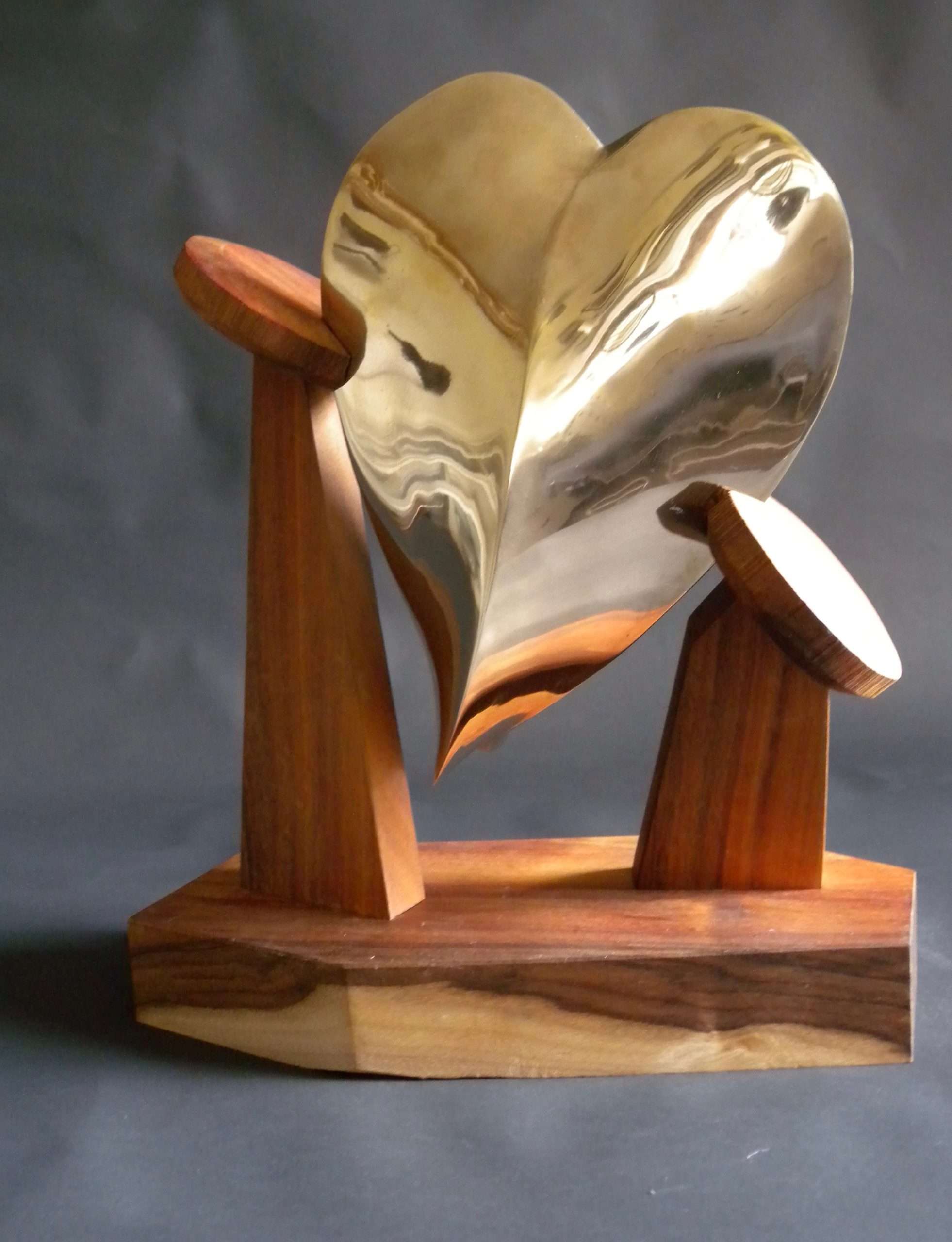
It’s always interesting to see how math builds on itself. Because we’re essentially only coming along as passengers for the ride as one formulaic derivation leads into another, while slowly but surely, we might be fortunate enough to unravel some of its mysteries. But in the final analysis, how does all of this relate to what the Chestahedron is said to represent — which is “the geometry of the heart?”
As we look back through the article, we can’t help but notice the sense of an unfolding drama. This is probably because so many of our claims appear to be very unlikely (if not outright impossible), and yet they’re being proven to be astonishingly true in every case. Maybe this should come as no surprise however, because what else would you expect from a shape that could be illustrating a mathematical model of the heart?
We’re not making an argument for that here, and a discussion of the heart is beyond the scope of this article. But the relationship it has to the Chestahedron is very compelling to say the least, and we would recommend checking out some of Frank’s videos to learn more about that. The Frank Chester Heart Lecture in 2011 discusses this in more detail, and he has many other lectures available on Youtube.
The Heart’s Higher Purpose
We’ve heard Frank say, “the heart’s real job is to continually balance all of the polarities we encounter in the world,” and that could be a perfect way to describe its higher purpose on a spiritual level. From our own observations of the math model, we might be going out on a limb to call it a “Continually Unfolding Drama Equalizer” (somewhat jokingly), but we think that may be one of the best ways to describe what the heart is actually doing.
Those theories will require a certain amount of speculation however, so we’re sure that many would try to pass them off as merely fanciful thinking. But no one can argue with the math, and it’s much harder to deny the incredible balancing performance being presented to us by the Chestahedron — through the math itself!
What you should also make sure to see if you haven’t is the gallery of Frank Chester’s research work at the link below. His three dimensional models are fascinating, and they illustrate much more about the Chestahedron than we’re able to cover by just showing the math!
Conclusion

Our research with the New Chestahedron Phi Model is still ongoing, and now that we have a complete new set of metrics established for it, there are many other types of experiments we can perform.
In particular, we made a fascinating new discovery recently when we were researching the geometry of ancient star forts. It turns out that a secondary five pointed star (constructed with the double pentagonal triangle rhombus shown in Figure 11) can be folded at the apex in the same way as the Chestahedron. We’re calling this new shape the “Star Fort Crystal,” and it’s raising some very interesting questions about what it might be relating to in the physical world! You can learn more about it at the link below,
Thanks for reading our articles, and feel free to post any feedback or questions you have in the Comments section below. Anyone is more than welcome to collaborate, and anyone is welcome to check our math! :-)
Star Fort Crystal Video
Follow Us On Social Media
Also be sure to follow our social networks where you can stay up to date on our latest research! And feel free to share your thoughts in the Comments section below.
Cite This Page As:
The Math Zone. “Chestahedron Seven Sided Geometry.” From MathZone.io — A Modern Exploration of Ancient Mathematics. https://mathzone.io/chestahedron-seven-sided-geometry/
New Chestahedron Phi Model PDF Press Release
> A New Paradigm In Euclidean Geometry (PDF)
Work Sited:
Weisstein, Eric W. “Equilateral Triangle.” From MathWorld–A Wolfram Web Resource. https://mathworld.wolfram.com/EquilateralTriangle.html


Just a reminder that this website has an open comments section on all of our articles, so please feel free to post your feedback below. We think these are important new discoveries about the Chestahedron, and we encourage sharing links to the article so more people can learn about these findings. You’re also welcome to cite the article in your own research, and we’re including a citation format you can use in our “Cite This Page” section above.